The Local Search Marketing Formula
First published 2011 · reviewed & updated July 2026. The framework for being found by the customers already looking for you — on Google, in the Map pack, and now inside AI answers. Get found, earn the click, convert, and get cited. We first published this when local search was brand new; the spine hasn't changed, so we kept it and added the layer 2011 didn't have.
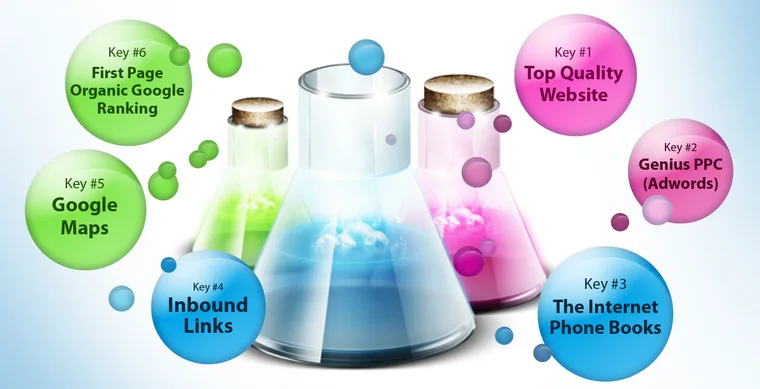
How the Local Search Marketing Formula works
Local search marketing has one job: turn the people already searching for what you do into customers. That job breaks into four moves — and the first three are the exact framework we published in 2011. The fourth is what changed.
- 1 · Be Found — show up where the search happens: the Map pack, organic results, and your Google Business Profile.
- 2 · Earn the Click — be the result they choose: reviews, a clear offer, and a fast, trustworthy page.
- 3 · Convert — the visit should compel action: a phone tap, a form, a booking, with nothing in the way.
- 4 · Get Cited — the 2026 addition: be the source AI answer engines name when someone asks for a business like yours.
From the 2011 original“Success on Google is first being seen, second generating interest in the form of calls or leads… once a prospect gets to your website it should wow them and compel them to do business with you.” The words are fifteen years old. The thesis — position yourself as the best company in your city for what you do — hasn't aged a day.
How to get found, earn the click, and convert
The same four moves, in plain English — what it is, and what it looks like when it's working.
1 · Be Found
Being seen where local intent lives: the Google Map pack, the organic results, and a complete, categorized Google Business Profile. In 2011 this meant ranking; in 2026 it also means consistent name, address, and phone plus schema an engine can read. In practice: a claimed, filled-out profile, one honest page per service, and the same business facts everywhere.
2 · Earn the Click
Being found isn't being chosen. Between you and the next result, the customer picks on signals: review volume and freshness, a clear reason to call, and a page that loads fast enough to trust. In practice: recent reviews you actually respond to, a specific offer above the fold, and a sub-two-second load.
3 · Convert
The visit has to compel action — the 2011 note said “wow them and compel them,” and that's still the job. In practice: a phone number one tap away on mobile, a short form (name, phone, service — nothing more), and no zip-code gate or ten-field intake between a ready customer and you.
4 · Get Cited
The move 2011 couldn't have: being the business an AI answer names. Ask ChatGPT or Google's AI for “the best [what you do] in [your city]” and the engine cites a few sources — you're in it or you're invisible. In practice: entity clarity across your site, profile and directories, answer-first content, and schema that tells machines exactly who you are.
The original Local Search Marketing Formula, 2011
The formula shipped in 2011 as a slide guide — here it is, recovered from our own archive and preserved exactly as it looked, annotated Google screenshots and all. The interface is a period piece; the four moves above are the same idea, brought current. The one thing it couldn't show you is the fourth screen — the AI answer that now sits above all three.
Original slides and PDF from nwesource.com, circa 2011 — recovered from our own archive and preserved unchanged. The six keys inside (quality website, smart AdWords, Google Maps, organic ranking, internet phone books, inbound links) are what we've distilled into the four moves above and brought current.
What’s changed in local search since 2011 — and what hasn’t
This page has been here, in one form or another, since local search was new. Here's an honest accounting of what time did to the formula.
Still true
Show up, get chosen, compel action. Reviews still matter. Being seen in more than one place still compounds trust. And the whole game is still about being the best-looking, best-sourced answer for your city and your service — not gaming a ranking.
What changed
The Map pack replaced ten blue links as the prize. Mobile became the majority of local searches. Page speed became a ranking and trust signal, not a nicety. And AI answer engines now sit above the results, citing a handful of sources — which added the fourth move.
New for 2026
Schema went from optional to load-bearing: machines that can't confirm your services, area, and identity simply don't cite you. Answer-first content — a real answer in the first sentence under a question-shaped heading — is what gets lifted into AI answers. That's the layer we added.
Local SEO, done for you — one business per market
Everything above is the framework — yours to use. Where we come in is execution: the profile optimization, the one-page-per-service build, the review system, the speed work, and the schema and entity cleanup that gets you cited. We run the whole formula for one business per market, so we're never optimizing competitors against each other.

Local search marketing questions, answered directly
What owners ask about getting found locally — answered first-sentence, no mysticism.
What is the Local Search Marketing Formula?
It's NW eSource's framework for turning local searchers into customers, first published in 2011: get found, earn the click, convert, and — added for 2026 — get cited by AI answer engines. The first three moves are the original formula; the fourth reflects how AI now sits above the search results. The through-line hasn't changed: be the best-sourced, most trustworthy answer for your city and your service.
Does a formula from 2011 still work for local SEO?
The spine does. Being found, getting chosen, and compelling action are timeless, and reviews and consistency still drive results. What changed is the terrain: the Map pack replaced ten blue links, mobile became the majority, page speed became a ranking signal, and AI answers now cite a few sources above the results. So we kept the original three moves and added a fourth — get cited — rather than throwing the framework out.
How do I get my business found in local Google search?
Claim and fully complete your Google Business Profile, keep your name, address, and phone identical everywhere, and publish one honest page per service you actually offer. Being found is the combination of a strong profile, consistent business data, and pages a search engine can clearly match to what a local customer typed — not a single trick.
What's the difference between the Map pack and organic results?
The Map pack is the block of three local businesses with a map at the top of local results; organic is the list of links below it. The Map pack wins the high-intent “near me” searches and is driven heavily by your Google Business Profile, proximity, and reviews. Organic rewards your website's content and authority. Local search marketing works both — they reinforce each other.
How do I get recommended by AI answers like ChatGPT and Google's AI Overviews?
Make your business unmistakable to a machine. That means entity clarity — your site, Google Business Profile, and directory listings all agreeing on who you are and where you work — plus answer-first content that states a real answer in the first sentence, and schema that confirms your services and area. AI engines cite a small number of clear, well-sourced businesses; the goal is to be one of them.
How long does local SEO take to work?
Some moves pay quickly — a completed profile and fresh reviews can lift visibility in weeks. The compounding parts, like content and authority, take a few months. Anyone promising page one overnight is selling something; the honest answer is that the fast wins come first and the durable gains build over a quarter or two.
Do I have to run Google Ads to show up locally?
No — the formula is about earned visibility: profile, reviews, content, and speed. Ads can buy immediate presence while the earned side builds, and the two work well together, but you don't need to pay per click to rank in the Map pack or get cited by AI. Those are won, not bought.
Can I run the Local Search Marketing Formula myself?
Yes — the framework is free and yours to use; that's the point of publishing it. The work is in the execution: profile optimization, one page per service, a review system, speed, and the schema and entity cleanup that earns AI citations. Businesses run it themselves all the time; where we come in is doing that work for you, for one business per market.
This is the first of a series.
The Local Search Marketing Formula is the flagship of a growing set of NW eSource formulas — named frameworks, kept current, free to use. More are on the way.
Where does your local search leak?
Pick the situation that fits. Free assessment — no commitment, no pitch.
Free assessment. No commitment. No pitch.