The Landing Page Formula
Created 2013, refined 2018, from an actual NW eSource client flyer · updated August 2026. Pages on your website are a chance to make a point — or maybe a sale. The flyer below laid out a four-part structure and a six-step process for turning one page into either. The structure held up; how fast you can test it didn't.
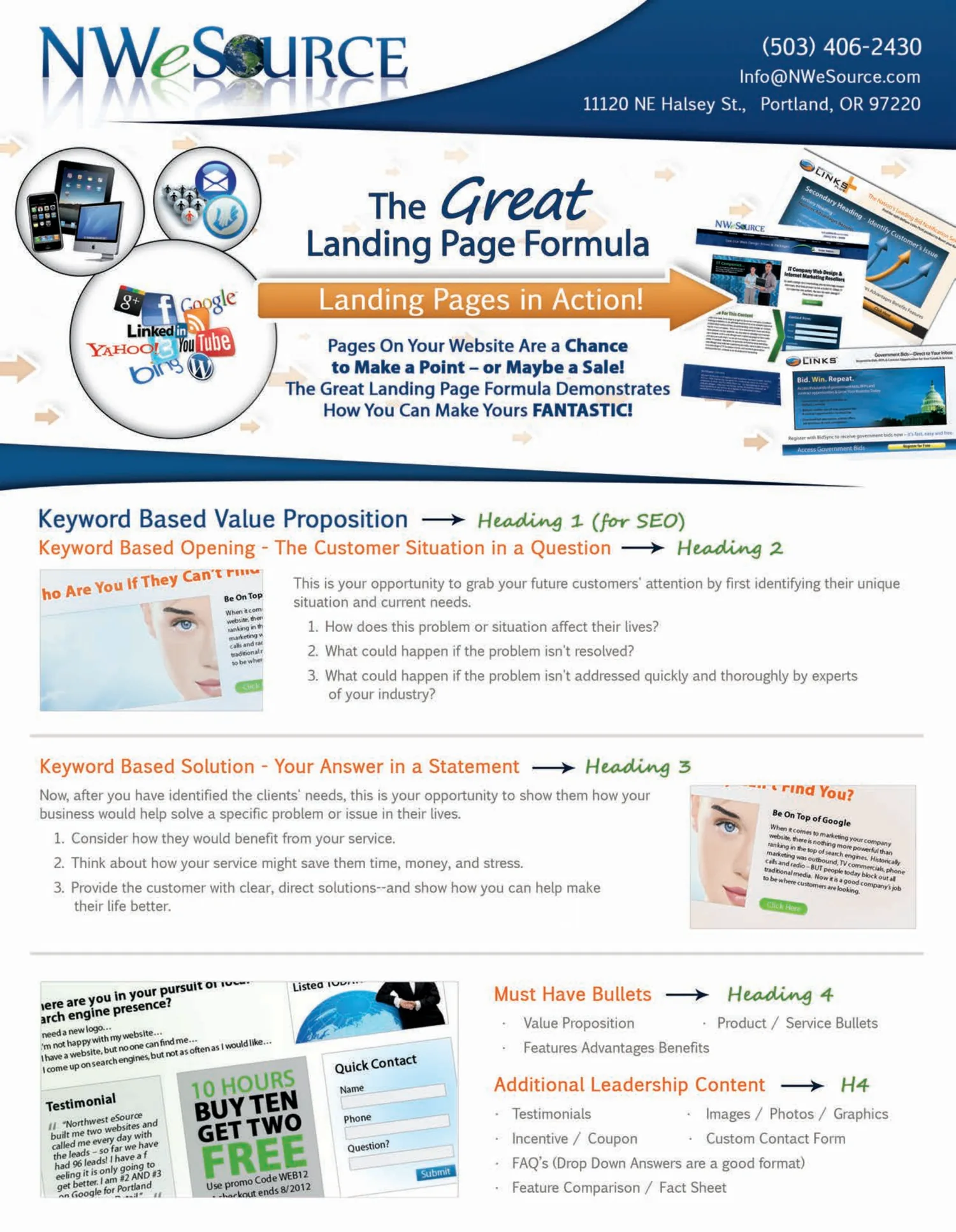
How the Landing Page Formula works
A landing page has one job: turn a click into a call, a lead, or a sale. The 2013 flyer broke that job into four heading levels — an SEO-ready structure married to a sales argument — the same four we're keeping today.
- 1 · Keyword-Based Value Proposition — the H1: your SEO headline and your one-line value statement, doing both jobs at once.
- 2 · The Customer's Situation, as a Question — the H2: name their problem before you sell them anything.
- 3 · Your Solution, as a Statement — the H3: answer the question you just asked, plainly.
- 4 · Must-Have Bullets & Leadership Content — the H4s: feature/advantage/benefit bullets, testimonials, images, an incentive, and a contact form.
From the 2013 original“Pages On Your Website Are a Chance to Make a Point – or Maybe a Sale! The Great Landing Page Formula Demonstrates How You Can Make Yours FANTASTIC!” That was the pitch across the top of a one-page flyer, printed under the banner “Landing Pages in Action!” Thirteen years later it's still the right way to think about a landing page.
The six-step process, in plain English
The back of the same flyer laid out the build sequence one step further — six steps, still the sequence we use today.
1 · Name the situation
What are your customer's situations? What problems are they facing? Consider the needs of your customers, and use direct, personable language to start a dialogue with potential clients.
2 · State the solution
How do you solve their problems? How are you qualified to solve their problems? With the customer's needs in mind, describe the solution you provide.
3 · Prove it with testimonials
Talk with past and current customers about their service with you. Use that feedback as a testimonial — real-life examples of how your service helps people.
4 · Show what's different
What is different about your service? Compare features, options, and competition between your service and others in the industry. Create a small comparison chart.
5 · Create the call to action
Strategize, and create calls to action. Incentivize them, call them to action — give the customer details on how to receive the service and why it would be beneficial to do so.
6 · Ask for the lead or the sale
Ask for the introduction — the lead — or with a form. Ask for the sale.
The original Great Landing Page Formula flyer, created 2013, refined 2018
The flyer shown above is real — recovered from our own client materials, dated April 2, 2013, and cleaned up in a 2018 re-export we're using here because it's more legible. Same document, same structure, thirteen years old this year. It also included two lists we've kept below: where else to reuse the same content, and which content types matter most on a landing page, in the order the flyer ranked them.
Leveraging the same content, recovered verbatim
The flyer's back page made a point we still make: the same landing page content works in more places than just the landing page.
Reuse the same content as
- A page on the primary website
- A landing page for a domain or website of its own
- A page in a website store
- A commercial video with the same content
- Content in a PDF for download
- Multiple blog articles about the topic
- A PPC landing page for direct sales online
- Multiple videos about the topic
- Content in a slideshow
Content types, in order of importance
- Service & product descriptions (briefs)
- Features, advantages & benefits, in bullet format
- Images & photos
- Testimonials
- Competitor comparisons
- Product/service feature comparisons
- FAQs
- Process explanations
- Discounts & incentives
- Disclaimers — what isn't covered or guaranteed
- Long copy with features, advantages & benefits
What’s changed about landing pages since 2013 — and what hasn’t
This formula has been sitting in our client files since before most of today's landing pages had a mobile version. Here's the honest accounting.
Still true
Name the customer's situation as a question, answer it as a statement, back it up with proof, and ask for the lead or the sale. The flyer's four-heading structure and six-step process still describe exactly what makes a landing page convert — we didn't touch either one.
What changed
The flyer's own device montage shows an iPhone, an iPad, and an iMac side by side, as if they carried equal weight. They don't anymore — most landing-page traffic now arrives on a phone mid-scroll, not a desktop in an office chair, and a “Quick Contact” form built for a mouse has to work with a thumb.
New for 2026
Schema markup and AI answer engines didn't exist as a factor in 2013 — a landing page was written for a visitor and a search engine crawler, full stop. In 2026 the same value proposition and solution statement can also get quoted directly by an AI answer engine, which is part of why testing them faster — see below — matters more than it used to.
What has AI changed about building a landing page? The step that took days now takes minutes.
The four-part structure hasn't moved. What changed is the cost of testing every part of it.
In 2013 you wrote one keyword-based value proposition and one customer-situation question, then lived with it — rewriting the headline meant another design pass and another wait on a developer.
AI drafts several keyword-based value propositions and opening questions in minutes, in the customer's own language, so testing which one lands is a rewrite, not a redesign.
The solution statement got written once during the build and rarely touched again, because touching it meant tracking down whoever wrote it the first time.
AI can restate the solution for a new offer, season, or audience the same day — the copy keeps pace with the business instead of lagging a step behind it.
The flyer's Heading 1–4 structure was built so a search engine, and a visitor, could parse the page. Schema markup wasn't part of the conversation in 2013.
The same heading structure now also feeds schema markup and AI answer engines, so the value proposition can get quoted directly instead of only ranked.
A landing page went live as one version. Finding out the opening question didn't land meant watching the lead count fall, not testing the question first.
AI can generate and reason about multiple versions of the opening question and the call to action before anything goes live, so the guess happens before launch, not after.
Landing pages, done for you — one flat price
Everything above is the framework — yours to use, free. Where we come in is execution: the value proposition and opening question drafted and tested with AI, the comparison chart, the contact form, and the schema markup that gets the page cited, not just ranked. One flat price, not a per-page invoice. Two ways to see the proof before you commit.
Landing page questions, answered directly
What owners ask about landing pages — answered first-sentence, no mysticism.
What is the Landing Page Formula?
It's NW eSource's four-part structure for a landing page that converts, created in 2013 from real client work and refined in 2018: a keyword-based value proposition (H1), the customer's situation as a question (H2), your solution as a statement (H3), and the must-have bullets and leadership content — testimonials, images, an incentive, and a contact form — underneath. A six-step build process runs underneath the structure, from naming the problem to asking for the lead or the sale.
Is a 2013 landing-page framework still accurate?
The structure holds up because it was never about trends — it's about the order a visitor needs information in: their problem, your solution, proof, and a clear next step. What's changed is how fast you can write and test each part. AI now drafts and rewrites the value proposition and opening question in minutes instead of days, which is the biggest practical shift since 2013.
What's the difference between a landing page and a regular website page?
A landing page has one job. A regular website page carries navigation, footer links, and often several competing calls to action. The original flyer put it plainly: a page on your website is a chance to make a point, or maybe a sale — a landing page is built to do exactly one of those, without the distractions.
Do I need a comparison chart on my landing page?
If your visitor is actively weighing you against a competitor, yes — the 2013 flyer calls this out directly under “what is different about your service.” A small, honest comparison chart does more to move a skeptical visitor than another paragraph of adjectives.
How has AI changed writing landing page copy?
The four-part structure hasn't changed. What changed is the cost of testing it. In 2013, rewriting a headline meant another design pass and another wait for a developer. AI now drafts several keyword-based value propositions and opening questions in the customer's own language in minutes, so testing which one lands is a rewrite, not a redesign — see What AI Changed above.
Can I run the Landing Page Formula myself?
Yes — it's published to be used, not sold. The structure, the six-step process, and the must-have bullets list are all here. Where we come in is the execution most owners hand off: the schema markup, the testing, and running the whole formula as part of a website or ad campaign build.
One formula in a growing series.
The Landing Page Formula joins NW eSource's set of Small Business Formulas — named frameworks recovered from our own client materials, kept current, free to use. More are on the way.
Where does your landing page leak?
Pick the situation that fits. Free assessment — no commitment, no pitch.
Free assessment. No commitment. No pitch.